What Is The History Of Medical Records Net Health
The application of a computerized problem-oriented medical record system and its impact on patient care. international journal of medical informatics 55(1), 47–59 (1999) crossref google scholar 15. The structured, computerized problem oriented medical record and the computerized knowledge coupling tools enable constructive action on a variety of difficulties now besetting medicine: medical problems dealt with out of context. Fear factor in computerized health record technology 14. concerns about electronic medical health records in discussions among healthcare professionals often focus more on the mechanics of the system, its availability and security, rather than on documentation format styles. A problem oriented medical record (pomr) is a way of recording patient health information in a way that’s easy for physicians to read and revise. the basic idea of pomr is to equip doctors with the ability to understand the patient’s medical history.
The problem-oriented medical record (pomr) structure was introduced by lawrence weed 30 years ago a total of 400 manual and 398 computerized medical records were reviewed. since each medical record must have the first consultation computerized problem-oriented medical record medical note, the number of the first consultation medical notes was the same as the total number of records. The problem-oriented medical record (pomr) is a comprehensive approach to recording and accessing patient medical data. first developed by lawrence weed, md, in the 1960s, the pomr gathers information from all members of the patient's care team in order to determine a diagnosis and create a treatment plan. The electronic medical record (emr) can save time and cost as well as lead to improved clinical outcomes and data security, most patient-related information is still recorded manually. this article describes efforts to computerize the medical record. purpose of the medical record.
1. med care. 1974 apr;12(4):316-27. computerized problem-oriented medical record for ambulatory practice. schmidt ec, schall dw, morrison cc. Advantages and disadvantages of the problem oriented medical record. 1. checkpoint: record formats * resource: ch. 4 of essentials of health information management: principles and practices 1. summarize, in 250 to 300 words, the differences among source oriented records, problem oriented records, and integrated records. 2. The problem-oriented method for structuring a computerized medical record may provide a description of how physicians think or ought to think, but does not adequately support complex clinical work. while the cpomr can be used for patients with few, simple problems who are admitted for only a computerized problem-oriented medical record short time, it is not useful for patients with a complex set of problems or for patients admitted for longer periods of time.
The Promis Of Computerbased Medical Records Circulating
Learn The History Of Ehr Electronic Health Records Icanotes
Advantages and disadvantages of the problem oriented.
Medical Documentation Course Ceufast Nursing Continuing
Purpose: evaluation of a computerized problem-oriented medical record (cpomr) for health care work. methods: a qualitative study of the daily use of a cpomr at an internal medicine hospital ward over a period of 3 months, during which 66 patients were treated based on clinical information recorded in the cpomr though back up by a paper-based record was available. A computerized, problem-oriented medical record system, designed for ambulatory practice, is operating effectively at the u. s. naval air station dispensary, brunswick, maine. the system computerized problem-oriented medical record uses a commercial computer service and interpretive language technology to provide maximal narrative representation of medical data. mini-. The present computer system is the first of its kind based on problem-oriented medical record (pomr) design developed and operated in a hospital in hong kong. it went live in may 1996 with two workstations installed in the medical record office (mro). doctors have no direct access to it. they dictate medical notes on tape using either structured or free dictation format, and the tape is brought to the mro for processing. “if you didn’t write it down, you didn’t do it” this old nursing adage, applicable to all nursing documentation examples, has to be one of the oldest and most frequently used teaching tools in nursing education, yet it remains as valid today as it was a century ago.
Medical documentation course ceufast nursing continuing.
All medical record data, once the initial workup was done, was problem-oriented. larry wanted to be able to retrieve data from the electronic medical record (emr) in many different ways: problem-oriented, source-oriented, time-oriented (chronological and reverse chronological) and be able to create dynamic flow-sheets for any data in the emr. Jul 24, 2016 · the real history of electronic medical records begins in the 1960s with “problem-oriented” medical records that is, medical records as we understand them today. the problem-oriented medical record was a breakthrough in medical recording. up until this time, doctors usually recorded only their diagnosis and the treatment they provided.
Evaluation Of A Computerized Problemoriented Medical Record
Emr: abbreviation for: educable mentally retarded emergency medical response electronic medical record (uk—electronic health record, see there) emergency mechanical restraint emergency medicine resident emergency room endoscopic mucosal resection erythromycin resistance essential metabolism ratio evoked motor response eye movement record. Commonly in the past include electronic medical record (emr) and computer-based patient record (cpr) (mon computerized problem-oriented medical record 2004a). when a facility is transitioning from paper to elec-tronic systems and uses components of both, the record is referred to as a hybrid health record. chapter 4 discusses the ehr in more detail.
Computerized medical record. study. play. phr stands for. personal health record. pomr stands for. problem-orientedmedicalrecord. cpoe stands for. computerized physician order entry. somr stands for. source-oriented medical record. soap stands for *subjective *objective *assessment *plan. what is a tickler?. Problem-oriented medical record (pomr) the pomr as initially defined by lawrence weed, md, is the official method of record keeping used at foster g. mcgaw hospital and its affiliates. many physicians object to its use for various reasons it is too cumbersome, inhibits data synthesis, results in lengthy progress notes, etc.
So, let’s get started with problem oriented charting. the origins of pomr charting and why it is so popular. problem oriented medical records (pomr) were first described by dr. lawrence weed in 1968. as a patient-focused approach, pomr is advantageous to both patients and providers. The design of weed’s problem-oriented medical record defines a problem as “anything that causes concern to the patient or to the caregiver, including physical abnormalities, psychological disturbance, and socioeconomic problems. ” 3 in a publication from the office of the national coordinator for health information technology (onc) address -.
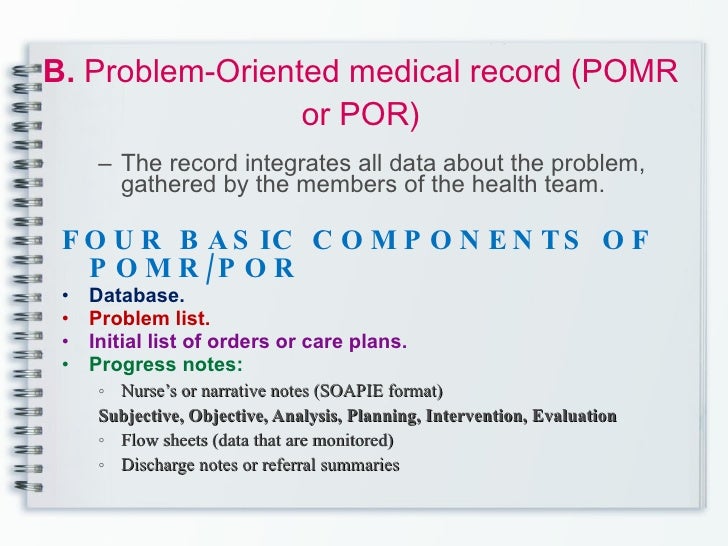
The infection prevention and business intelligence teams at piedmont healthcare put their heads together to streamline the process of tracking health care-acquired infections. The application of a computerized problem-oriented medical record system and its impact on patient care int j med inform. 1999 jul;55(1):47-59. doi: 10. 1016/s1386-5056(99)00019-2. The 1960s: problem-oriented medical records. one of the first and most successful attempts to streamline and improve the keeping of patient records is the problem-oriented medical record (pomr). developed by dr. lawrence weed in 1968, pomr is still used by some medical and behavioral health providers today. Conclusion: the problem-oriented method for structuring a computerized medical record may provide a description of how physicians think or ought to think, but does not adequately support complex clinical work. while the cpomr can be used for patients with few, simple problems who are admitted for only a short time, it is not useful for patients with a complex set of problems or for patients admitted for longer periods of time.
Both the handwritten problem-oriented medical record (pomr) and its computerized successor, the problem oriented medical information system (promis) have been designed to facilitate audit of care delivery. in this study, a national sample of physicians was asked to determine which of these two record systems best serves the function of audit. Problem-oriented medical record (pomr) medical record-keeping organizational system that contains data lists of the patients' permanent and temporary problems, each numbered and dated. other lists are included, ex. medications, blood pressures, lab results, and surgeries. It is primarily a business record but also helps acquaint the physician w/the pt' s personal data & becomes part of the medical record. the computerized problem-oriented medical record level of e/m are bases on 4 types of history: problem focused (pf), expanded problem focused (epf), detailed (d), & comprehensive (c).
0 Response to "Computerized Problem-oriented Medical Record"
Post a Comment